

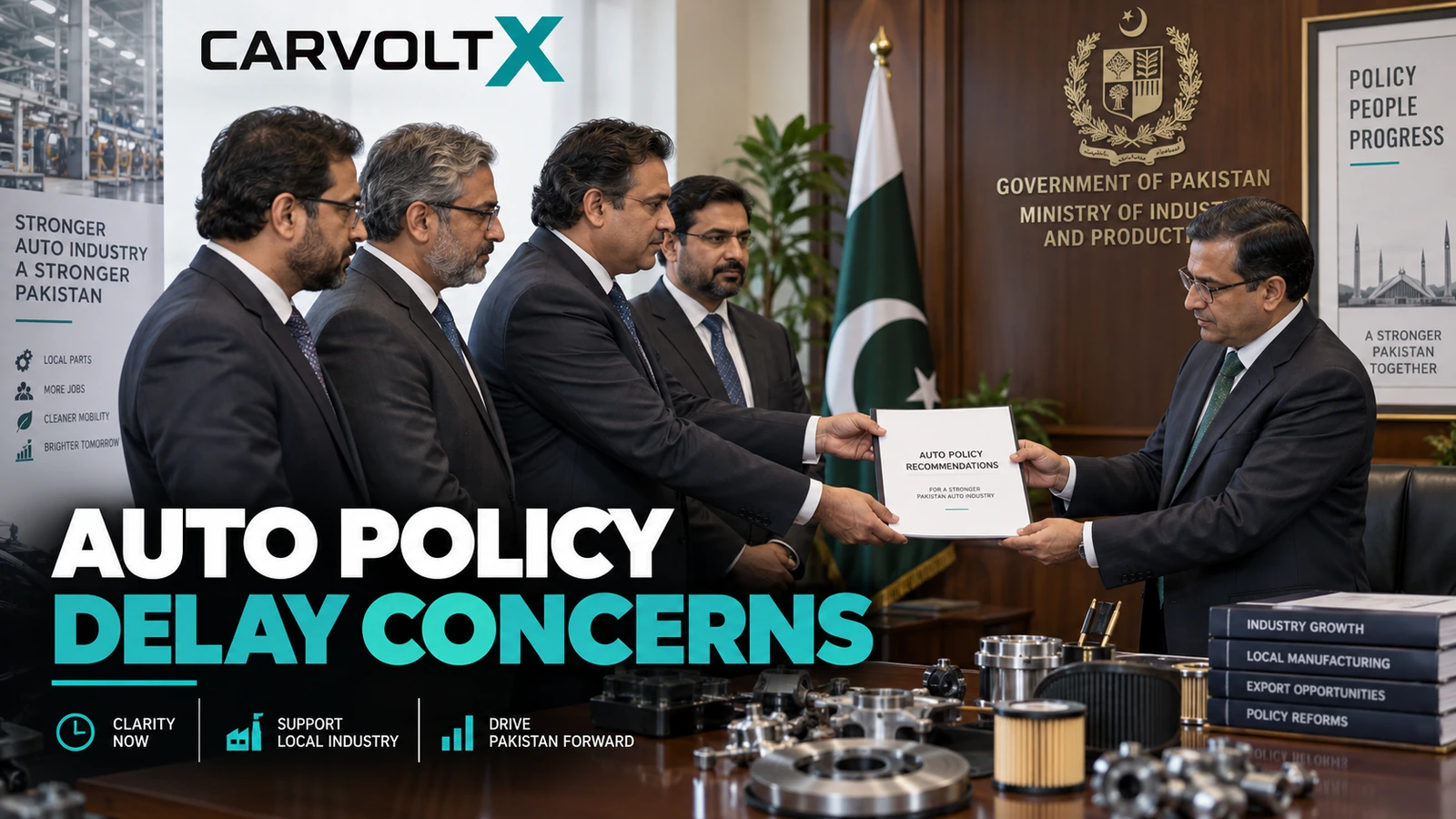
Pakistan Association of Automotive Parts and Accessories Manufacturers wrote to the Prime Minister over delays and concerns linked to the next auto policy and tariff direction. Parts makers argue that long-term investment requires predictable rules, while consumers benefit from competition, safety and affordable vehicles.
The letter represents an industry stakeholder's position, not the final government decision. Its claims should be compared with official trade data, localization evidence and responses from other affected groups.
A credible policy should balance competition with domestic capability, set measurable export and quality goals, and avoid abrupt changes that strand investment. Consumers also need transparent pricing, safety standards, warranty protection and genuine model choice.
Readers should wait for the formally approved policy and statutory notifications before treating proposed tariff changes as active. Implementation dates and transitional rules will determine the practical effect.

Read the status carefully
Date, market and stage determine what an automotive headline actually means. A launch in China is not a Pakistan launch. A planned underpass is not a completed road. A price circular applies from a stated date and may later be replaced. An investigation raises questions but does not establish a final finding.
Readers should identify the responsible primary source and retrieve its latest dated document. Approval, booking, production, delivery and completion are different milestones. If a local price, variant, schedule or outcome has not been confirmed, it should remain TBA rather than being estimated.
Practical checks before acting
Vehicle buyers should obtain a written quotation showing the exact trim, ex-factory amount, taxes, registration, freight, insurance, booking terms and delivery estimate. EV and PHEV buyers should confirm battery warranty, charging standard, usable range assumptions and service coverage. Use the CarvoltX comparison, on-road, EMI, range and charging tools with conservative inputs.
For infrastructure, fuel and policy updates, check the relevant government notification, approved scope and effective date. For connected-car privacy, review app permissions, linked accounts and the manufacturer's privacy choices. Avoid sharing more data than a feature needs, and remove personal accounts before selling a vehicle.
What to verify next
The next useful evidence may be a price list, homologated specification, delivery confirmation, tender, sales table, fuel notification, investigation order or policy publication. Repetition across many news pages is not independent verification when each repeats the same unsupported source.
Every number needs a definition. Range depends on a test cycle. A sales increase needs a baseline and product mix. A price change needs the previous and new effective periods. A power claim needs a unit and market. A project cost may change during design and procurement.
Why this matters
Automotive decisions affect safety, time and household budgets. An incorrect trim can ruin a comparison, an outdated fuel price can distort transport costs, and an unconfirmed delivery promise can lock up a deposit. Clear uncertainty is better than false precision.
Keep copies of official quotes, receipts and notices. If two authoritative sources conflict, contact the organization responsible for the product or rule. Recheck immediately before acting because later documents can supersede the dated position described here.
A useful decision framework
Write down the claim, date, market and action it appears to require. Decide what primary evidence would prove it. Compare total ownership or implementation costs rather than one headline figure. For a car, include financing, energy, insurance, maintenance, tyres, parts and resale. For a road project, include construction disruption, drainage, pedestrians and maintenance.
Independent inspection can add confidence for a vehicle, but it does not replace official documentation. Likewise, commentary can help explain policy, but only the final notification establishes the applicable rule.
Bottom line
Use the announcement as a starting point and the current official record as the decision point. Confirm the correct model, place, date and scope, then assess how it fits your route, budget or ownership needs.
Before publication, place the source date beside every time-sensitive claim and remove any implication that an old price or schedule is still active. Before purchase, inspect the actual vehicle and reconcile its identification details with the invoice and warranty. Before relying on a public project or policy, confirm that the approving document has moved into implementation. These small checks expose gaps that a short announcement cannot cover.
Update the record openly when a later primary source changes the position. Readers benefit from knowing what changed, when it changed and who confirmed it.